
Any digital marketing specialist will tell you: the rollout of automated bidding and campaign consolidation has fundamentally transformed online advertising. Second only to the GA4 transition, Google’s sundowning of Smart Shopping clouded the future of ecommerce marketing with uncertainty.
Performance Max came packaged with a pre-fixed menu of diverse placements—YouTube in a bottom-funnel ecommerce campaign? Display inventory mixed with search clicks?
With extensive testing and millions in managed media spend, the uncharted waters have been well-mapped. Here are the five key lessons our digital marketing team has learned from running Performance Max campaigns.
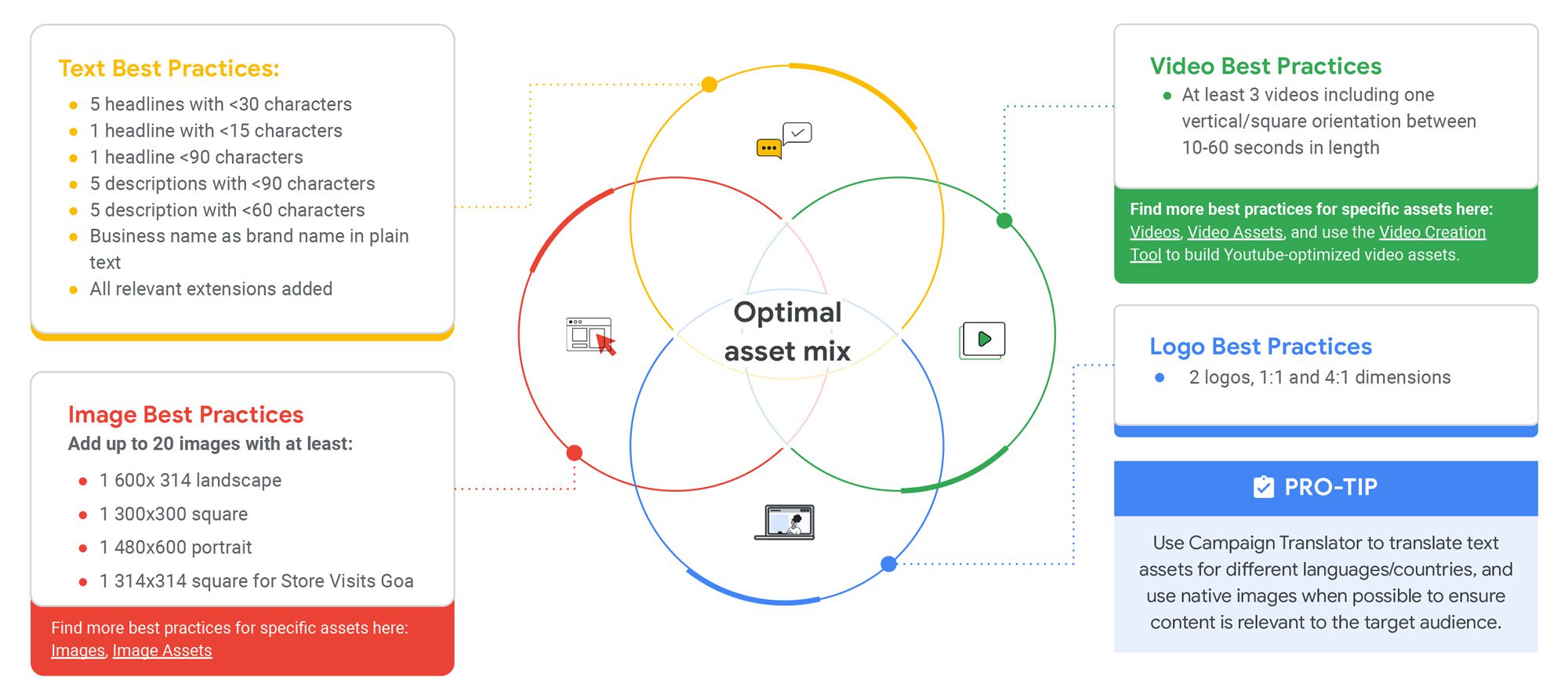
Optimal Asset Mix Recommended by Google
1. Automation Should Not Inhibit Optimization
Though the industry narrative often praises machine learning algorithms, digital marketing specialists cannot afford to let optimization muscles atrophy. Never “set it and forget it.” Strong, scalable performance relies on continuous manual steering regardless of automated bidding.
We have found significant performance lifts by regularly adjusting:
- Account-Level Negative Keywords: Essential for filtering out irrelevant searches, job seekers, and competitor queries that waste budget.
- Landing Page Exclusions: Refine traffic routing by excluding pages like return policies, terms of service, and blog articles from automatic URL expansion.
- Conversion Value Rules: Value-based bidding allows advertisers to add bid multipliers for high-value audiences, geographic regions, or device types, helping the algorithm prioritize customers with the highest lifetime value.
2. Audience Signals Shorten the Learning Runway
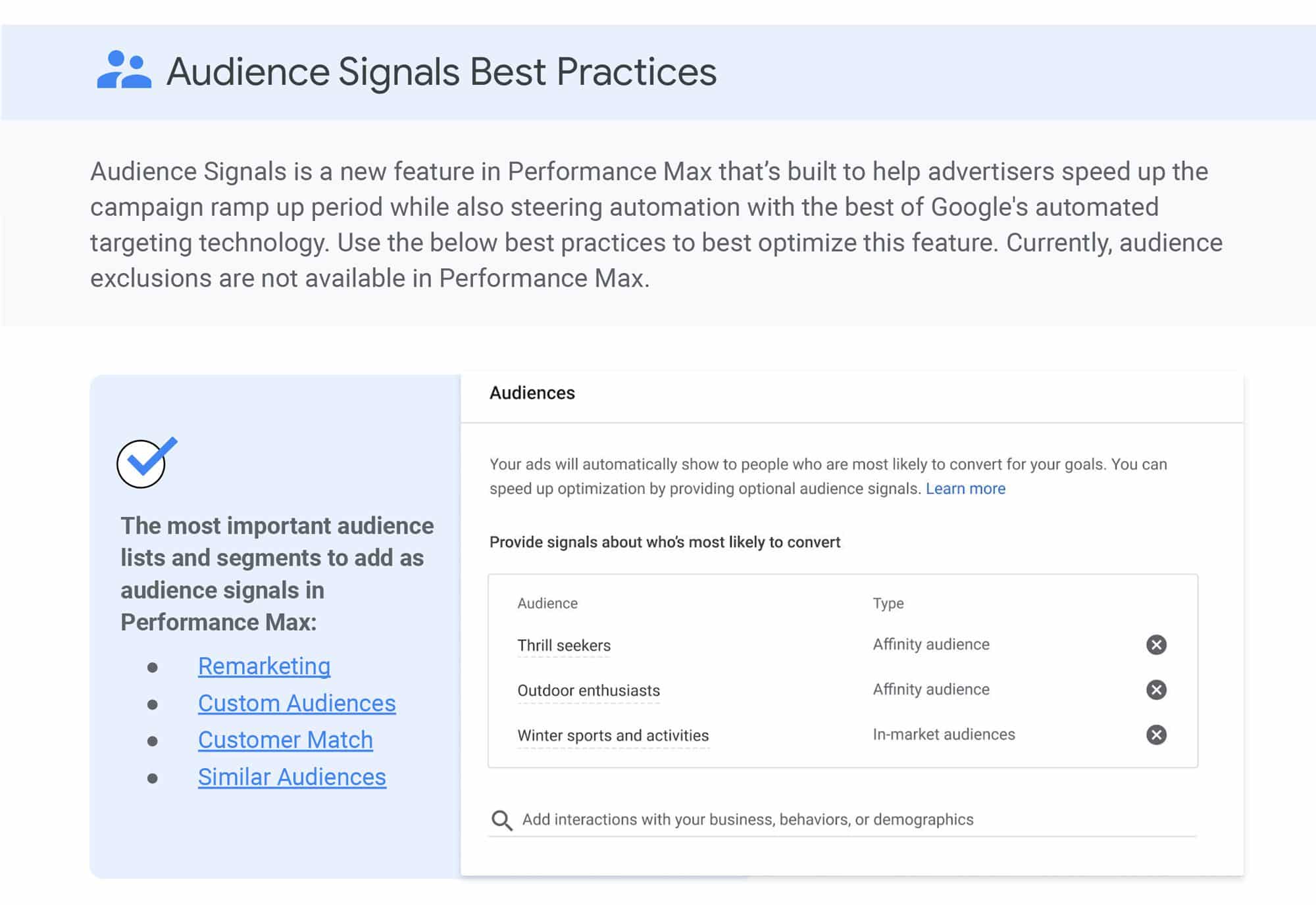
Audience Signals Best Practices Recommended by Google
Audience signals are not rigid targeting restrictions; rather, they are a vital springboard for Google’s machine learning. Feeding the algorithm your cleanest, highest-converting first-party data accelerates the initial discovery phase and steers automated bids in the right direction.
Clear audience signal best practices include:
- High-LTV Customer Match: Upload customer lists of repeat purchasers and VIP buyers.
- Recent Converters: Retarget users who converted in the past 30–60 days.
- Custom Search Intent: Build lists using top-performing non-brand search terms.
- Keep audience signals focused—stick to your top 2–3 revenue-driving segments per asset group.
3. Campaign Breakout Opportunities Are Endless – Be Strategic
Consolidating everything into a single PMAX campaign rarely maximizes profit. Align campaign breakouts with specific business and financial targets:
Scenario A: Maximizing Gross Profit Margins
- Group hero, high-margin products into a dedicated campaign with a moderate target ROAS (tROAS) to capture maximum volume.
- Place lower-margin or commodity items into a separate campaign with a high tROAS threshold to protect profitability.
Scenario B: Clearing Excess Inventory
- Isolate overstocked SKUs into a temporary clearance PMAX campaign with a lower tROAS target, freeing up cash flow without dragging down core campaign performance.
4. Product Feed Optimizations Drive Real ROAS
Google Shopping listings remain the conversion backbone for ecommerce PMAX campaigns. Optimizing your Google Merchant Center product feed gives your brand a definitive edge over competitors relying on default store exports.
Key feed optimization tactics:
- Descriptive Product Titles: Include brand, category, material, color, and size in titles to match user search intent.
- Custom Labels: Tag products by margin tier, seasonality, or sales velocity (
TopSeller,LowMargin,Clearance). - Complete Metadata: Populate GTINs, MPNs, Google Product Categories, and shipping attributes to qualify for enhanced listings and merchant promotions.
Feed management solutions like Feedonomics or Simprosys make managing complex catalog rules straightforward and scalable.
5. Performance Max Is Key to Driving eCommerce Growth
Performance Max has matured into an indispensable engine for multichannel digital marketing. When paired with high-quality creative assets, accurate conversion tracking, and strategic steering, it delivers unprecedented reach and incremental revenue across Google’s advertising network.
To compare how PMAX stacks up against traditional search and shopping, read our analysis on Performance Max vs. Search, Demand Gen & Shopping.