When Google introduced Performance Max (PMAX) to advertisers in late 2021, the digital marketing community reacted with understandable apprehension. Automation had been creeping into Google Ads for years, but PMAX represented a fundamental shift: a single campaign type designed to serve ads across Search, YouTube, Display, Discover, Gmail, and Maps using machine learning.
Early adopters quickly voiced valid frustrations:
- Lead Gen brands saw spam and poor lead quality at launch.
- Ecommerce brands noticed minimal incrementality as PMAX honed in on “easy” conversions (such as branded search terms).
- A lack of transparency in reporting the root causes of strong performance (search terms, placements, creative performance, targeting) left advertisers frustrated and without actionable answers for leadership.
Enter scrutiny and distrust. Over the following years, Google listened to advertisers and provided solutions, including search term insights, brand exclusion lists, asset group reporting, and placement exclusions.
Now, let’s explore how Performance Max stacks up against Google’s core campaign types:
- Search
- Standard Shopping
- Demand Gen
Performance Max vs. Search
Recommendation: Run Both!
Two ad campaign types that work great as complementary tools. With strong 1st-party data, high-converting creative assets, and an optimized website, both will drive performance for your business.
PMAX Advantages
- Search category & theme creation: Broad discovery across intent-based queries.
- Contextual targeting: Leverages landing page content and custom audience signals.
- Multi-channel reach: Serves simultaneously across Google’s entire portfolio.
- AI automation: Dynamically optimizes bids and creative combinations for conversions.
- Diverse inventory: Access to YouTube, Display, Gmail, Maps, and Discover.
Search Advantages
- Single channel delivery: Dedicated control over keyword intent and search queries.
- Granular campaign structure: Single-keyword ad groups (SKAGs) or tightly grouped themes.
- Targeting precision: Specific audience segment targeting with bid adjustments.
- In-depth bid controls: Manual CPC or portfolio strategies with minimum/maximum caps.
- Tighter messaging control: Direct control over headline-to-description mapping.
- Detailed reporting: Full visibility into search query performance.
When running both in an account, Google prioritizes identical exact-match keywords in Search over PMAX. However, for phrase and broad-match keywords, the campaign with the highest Ad Rank will win out. While some cannibalization can occur, advertisers often benefit from a lower blended CPA.
For ecommerce businesses, PMAX is often your strongest-performing campaign type due to its integration with Google Shopping. For lead generation businesses with monthly budgets under $5K, the tighter query controls of Search should capture high intent first before expanding into multi-channel PMAX.
Performance Max vs. Standard Shopping

Recommendation: PMAX for most scenarios
The shopping comparison is especially relevant for ecommerce brands deciding how to allocate product advertising budgets. Recently, Google updated campaign prioritization so that PMAX no longer automatically supersedes Standard Shopping; ad delivery is now determined by Ad Rank, mirroring Search auction mechanics.
PMAX still maintains key advantages over Standard Shopping when it comes to algorithmic machine learning:
The Case for PMAX
- AI-driven product delivery: Serves products across Shopping, YouTube, Display, and Search.
- Full-funnel touchpoints: Reaches consumers from discovery to bottom-funnel purchase intent.
- Value-based bidding: Optimizes for conversion value and high-margin product orders.
- Simplified campaign management: Consolidates multiple ad networks into a unified campaign.
The Case for Standard Shopping
- Product-level bidding: Granular bid overrides for individual SKUs or product groups.
- Negative keyword lists: Direct query sculpting without needing Google representative intervention.
- Transparent SKU reporting: Granular visibility into impressions, clicks, and ROAS per item.
- Inventory liquidation: Easier to push underperforming or clearance inventory specifically.
Performance Max vs. Demand Gen

Recommendation: Both, with caveats:
- Ecommerce: Advantage PMAX
- Travel & Hospitality: Advantage Demand Gen
- Lower Budgets: PMAX only
Demand Gen focuses primarily on building mid- and upper-funnel pipeline through YouTube, Gmail, and Discover feeds, whereas Performance Max directly optimizes for purchase or lead conversions. Experienced performance marketers benchmark Demand Gen campaigns against social platforms (Meta, Pinterest, TikTok) to evaluate engagement efficiency.
PMAX Strengths
- Conversion-first optimization: Built to generate immediate purchases and high-intent leads.
- Omnichannel coverage: Automatically covers search intent plus display and video.
- Merchant Center integration: Drives high-volume product listing ad delivery.
Demand Gen Strengths
- Granular audience targeting: Lookalike segments, custom intent, and detailed demographics.
- Placement & channel controls: Advertisers can opt out of specific placements (YouTube Shorts, in-stream, Discover, Gmail).
- Creative visual storytelling: Ideal for video hooks, lifestyle imagery, and scroll-stopping carousels.
- Pipeline generation: Strong at driving micro-conversions (add-to-carts, email signups, quiz completions).
Why No Performance Max vs. Display Comparison?
Recommendation: PMAX.
While traditional Google Display Network (GDN) campaigns retain niche relevance for remarketing, Performance Max consistently outperforms standalone Display in conversion efficiency.
Because GDN can generate lower-quality clicks, seasoned advertisers frequently tighten PMAX by applying Content Suitability exclusions at the account level. Advertisers with significant spend experiencing diminishing returns should explore programmatic DSPs rather than legacy GDN.
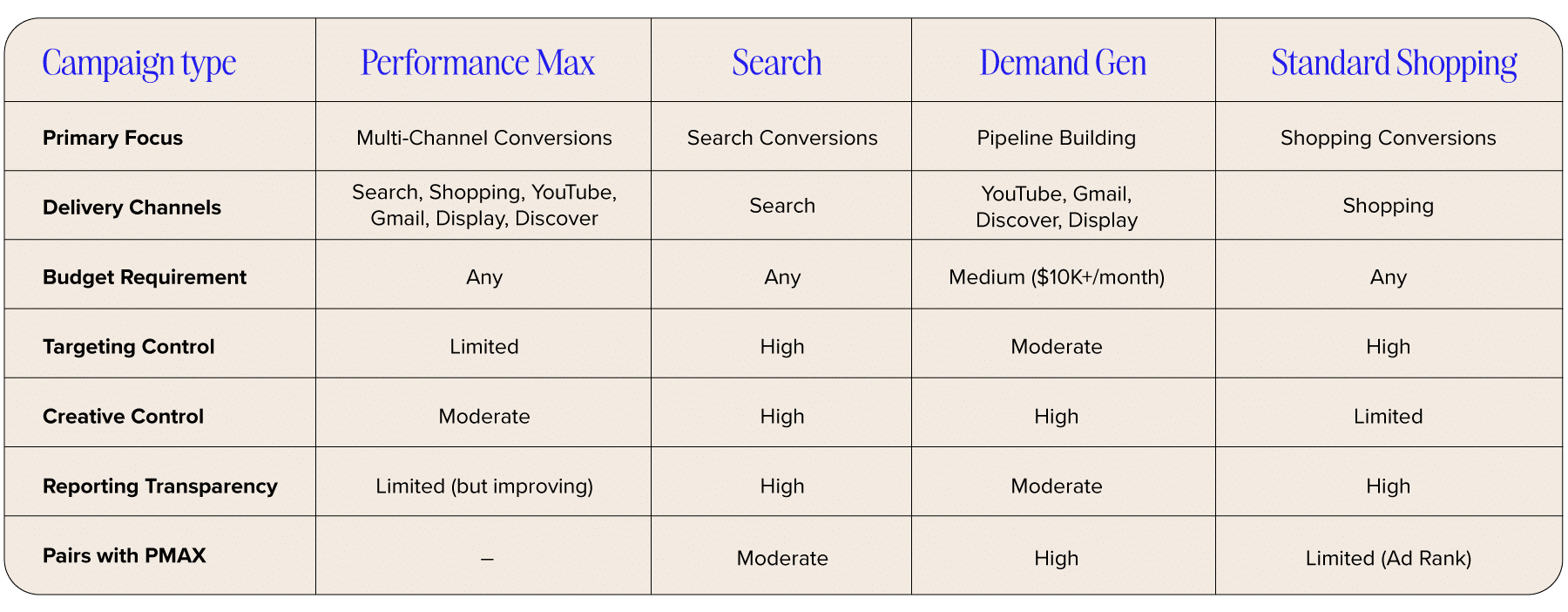
Performance Max Reference Chart
Use this quick-reference matrix to guide your Google Ads campaign architecture:
Performance Max vs. The Rest: Who Wins Out?
The classic answer is “it depends.” Advertisers in 2026 have access to a sophisticated suite of campaign options. Relying solely on PMAX might help you hit initial goals, but combining campaign types based on budget, conversion volume, and product catalog size delivers the highest return.
Check out our guide on 5 things we have learned from 1 year of PMAX and our step-by-step tutorial on setting up a Google Performance Max campaign to refine your setup.
Need expert help determining your ideal Google Ads campaign mix? Request a free audit with <imajery> today to scale your paid media with confidence.